VLF Tan Delta Cable Testing Solution
Integrated VLF Withstand & Tan-Delta Test System
Precision 0.1 Hz pure sine wave withstand, automated 3-tier tan-delta diagnostics, and 10 kV DC sheath testing for medium-voltage cables — built to IEEE 400.2 / EN 50191 for compliant, zero-damage field testing.
Integrated Cable Diagnostic System for Medium-Voltage Infrastructure
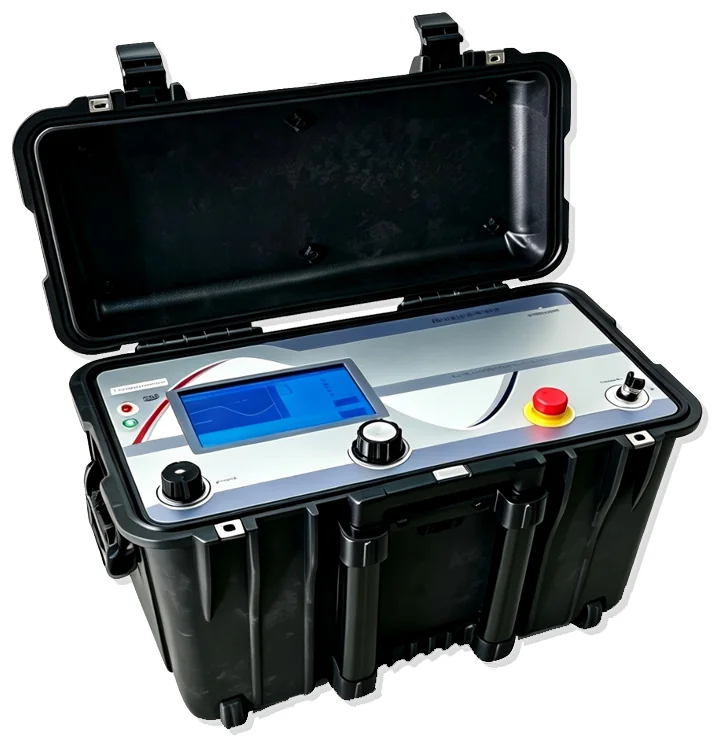
Engineered for MV cable commissioning, after-lay acceptance, and predictive maintenance. The VLF Tan Delta cable testing solution integrates 0.1 Hz pure sine wave withstand, automated 3-tier tan-delta diagnostics (1×10⁻⁴ accuracy), and 10 kV DC sheath fault pinpointing into a single 22 kg portable unit—enabling complete, non-destructive insulation health assessments in the field.
Dual Test-Connection Configurations
Two wiring setups to suit varying field test requirements
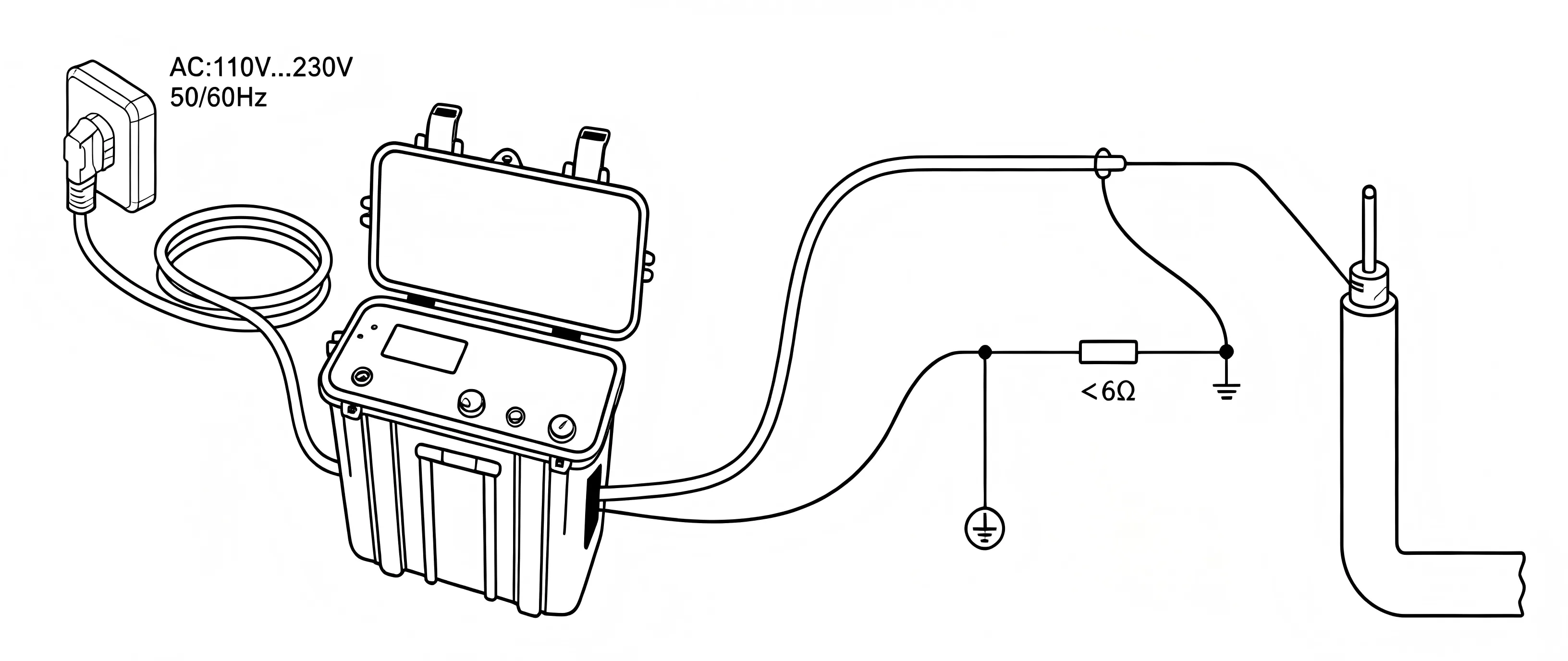
Main‑Cable Withstand & Tan‑Delta Test
Standard VLF withstand & tan‑delta connection for medium‑voltage cable commissioning, after‑lay acceptance and routine diagnostic testing to IEEE 400.2.
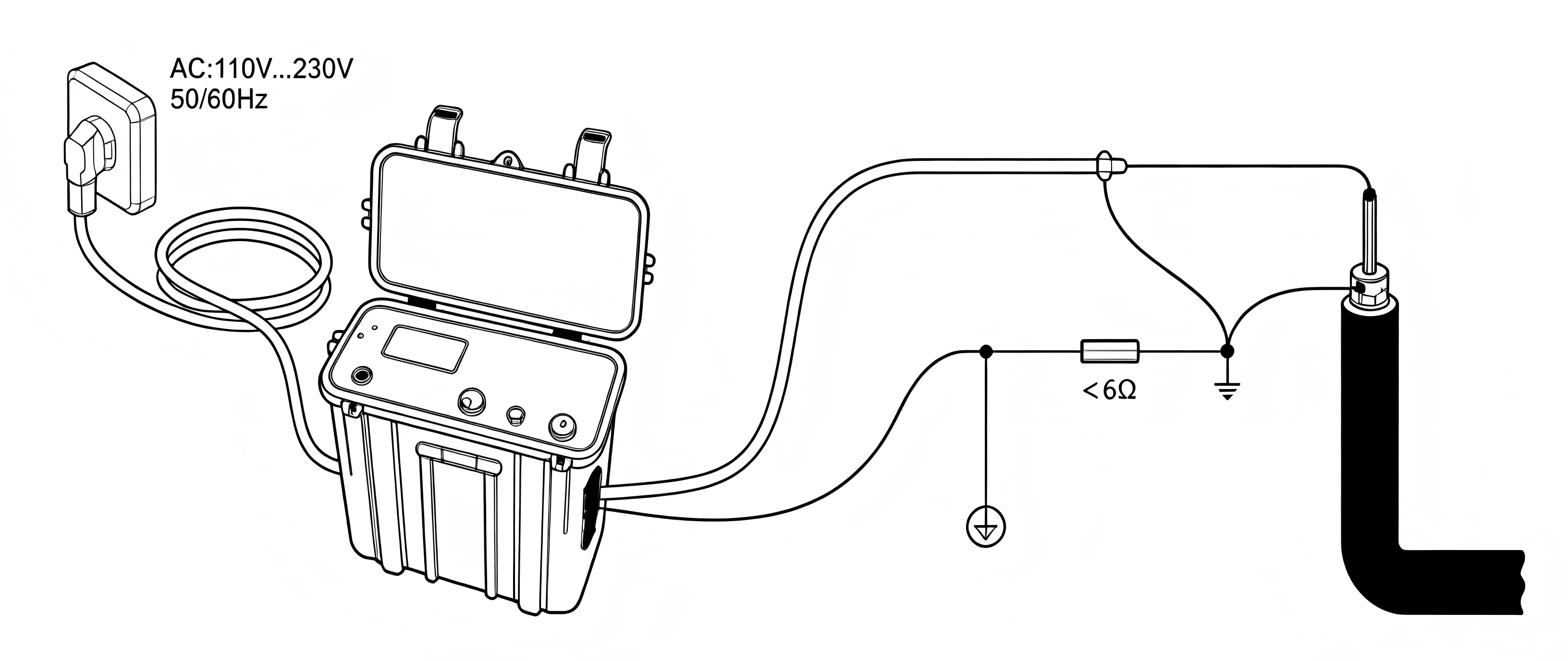
Outer‑Sheath DC Test & Fault Pinpointing
Dedicated DC wiring for outer‑sheath integrity verification and sheath‑fault pinpointing to IEC 60229.
Built for Cable Diagnostics in the Field
Six capabilities purpose-built for medium-voltage cable commissioning, after-lay testing and predictive maintenance in the field.
Core Technical Features
All-in-One Ultra-Low Frequency Test Capabilities for Complete Medium-Voltage Cable Insulation & Sheath Diagnostics — IEEE 400.2 & CENELEC HD 620 S1 Compliant
VLF-34kV delivers up to 24 kV RMS / 34 kV peak, VLF-45kV up to 31.8 kV RMS / 45 kV peak, plus ±5 kV DC and trapezoidal square-wave whose slope auto-adapts to cable capacitance. Withstand, tan-delta and leakage-current testing share one instrument.
Automatic tan-delta cycle across 0.5 Uⁱ / 1.0 Uⁱ / 1.5 Uⁱ captures tanδ, capacitance and insulation-resistance data and grades the cable into light / moderate / severe degradation — no manual step-voltage tuning.
Dedicated sheath testing up to 10 kV DC with fault pinpointing, plus PC software that batches A / B / C phase readings into visual reports and curves. Real-time HV waveform and V/I display keep every test in view.
End-to-End Engineering
Full cable diagnostic workflow from on-site testing to data analysis & reporting
Multi-Waveform Withstand
Automated Tan-Delta Cycle
Breakdown & Sheath Protection
Technical Specifications
Complete electrical and mechanical specification overview
| Parameter | VLF-34kV | VLF-45kV |
|---|---|---|
| General | ||
| Power Consumption | max. 300 VA | max. 400 VA |
| Reverse Voltage Protection | 13 kV | 15 kV |
| Data Interface | USB 2.0 | USB 2.0 |
| Dimensions (W x H x D) | Peli Case 430 x 240 x 340 mm | Peli Case 430 x 240 x 340 mm |
| Weight | 22 kg | 22 kg |
| Ambient Temperature (Operating) | -10 °C to +50 °C | -10 °C to +50 °C |
| Storage Temperature | -20 °C to +60 °C | -20 °C to +60 °C |
| Parameter | VLF-34kV | VLF-45kV |
|---|---|---|
| Output Voltage | ||
| Output Voltage (Sine Wave) | max. 24 kV RMS (34 kV PEAK) | max. 31.8 kV RMS (45 kV PEAK) |
| DC Voltage | ±1–34 kV | ±1–45 kV |
| Resolution | 0.001 kV | 0.001 kV |
| Accuracy | 1% | 1% |
| Parameter | VLF-34kV | VLF-45kV |
|---|---|---|
| Output Current | ||
| Measurement Range | 0–14 mA | 0–14 mA |
| Resolution | 1 μA | 1 μA |
| Accuracy | 1% | 1% |
| Maximum Capacitance Load | 0.1 Hz @ 0.5 μF / 24 kVrms / 34 kVpeak 0.05 Hz @ 1.0 μF / 24 kVrms / 34 kVpeak 0.01 Hz @ 8.0 μF / 18 kVrms / 25 kVpeak | 0.1 Hz @ 0.5 μF / 31.8 kVrms / 45 kVpeak 0.05 Hz @ 1.0 μF / 31.8 kVrms / 45 kVpeak 0.01 Hz @ 5.0 μF / 22 kVrms / 31 kVpeak |
| Parameter | VLF-34kV | VLF-45kV |
|---|---|---|
| Dielectric Loss Factor Measurement | ||
| VLF-Sine | 1–24 kV rms | 1–31.8 kV rms |
| Load Range | 1 nF – 8 μF | 1 nF – 5 μF |
| Resolution | 1 × 10⁻⁻⁴ | 1 × 10⁻⁻⁴ |
| Accuracy | 1 × 10⁻⁴ | 1 × 10⁻⁴ |
| Measurement Range | 1 × 10⁻⁴ ∼ 9999.9 × 10⁻⁴ | 1 × 10⁻⁴ ∼ 9999.9 × 10⁻⁴ |
| tanδ Measurement Frequency | 0.1 Hz | 0.1 Hz |
Other maximum withstand-voltage models — 40 kV, 65 kV, 80 kV, 90 kV — are available on request. Contact us for details.
Security & Compliance
Multi-layer protection and conformity to global industry specifications
Certifications
| EN 50191 (operator safety) | Compliant |
|---|---|
| VDE 0104 (HV test equipment) | Compliant |
| HD 620 S1:1996 (cable testing) | Compliant |
| HD 621 S1:1996 (cable testing) | Compliant |
| CE LVD 2014/35/EU | Compliant |
| CE EMC 2014/30/EU | Compliant |
| GB/T 26852 (power industry) | Aligned |
Equip Your Crew with the VLF Tan Delta Cable Testing Solution?
Two-person certified operation +Peli-case portable for indoor, trench and outdoor use +firmware updates over USB +procedure templates for substation / utility / industrial cable commissioning.
Need another maximum withstand voltage? 40, 65, 80 and 90 kV models are available on request — contact us.
VLF Tan Delta Test, Cable Tan Delta Testing — One Measurement, Several Names
Field crews and buyers request this measurement under several names. All of them refer to the same 0.1 Hz dielectric-loss reading described on this page.
Technical FAQ
The questions utility and MV maintenance engineers ask before specifying a VLF test set — answered from the published specification.
What is VLF Tan Delta testing, and why is it used for medium-voltage cables?
VLF (Very Low Frequency) Tan Delta testing is a non-destructive diagnostic method used to evaluate the overall insulation degradation—such as water-treeing, moisture ingress, and contamination—in medium-voltage (MV) cables. Operating at 0.1 Hz, it measures the loss angle (tanδ) to quantify dielectric losses without causing electrical stress or damage to healthy XLPE or EPR insulation.
What is the difference between VLF tan delta and partial discharge (PD) diagnostics?
VLF Tan Delta measures global insulation degradation across the entire cable length, calculating average dielectric loss to grade cable health (e.g., light, moderate, severe). In contrast, Partial Discharge (PD) testing identifies localized insulation defects, such as electrical trees, joints/termination flaws, or voids. For complete cable commissioning and predictive maintenance, utility engineers typically combine VLF withstand, Tan Delta, and PD diagnostics.
Which standards govern VLF Withstand and Tan Delta testing?
VLF withstand and Tan Delta testing procedures are governed by international industry standards, including:
- IEEE 400.2: Guide for Field Testing and Evaluation of the Insulation of Shielded Power Cable Systems Using VLF.
- CENELEC HD 620 S1 / HD 621 S1: European standards for testing distribution cables with extruded and impregnated paper insulation.
- IEC 60502-2: Specification for power cables with extruded insulation for rated voltages from 1 kV up to 30 kV.
How is an automated 3-tier tan delta test performed on an MV XLPE cable?
A standard automated Tan Delta assessment applies a 3-tier voltage step sequence based on the cable’s rated phase-to-ground voltage (U₀):
- 0.5 U₀: Baseline assessment below normal operating stress.
- 1.0 U₀: Normal continuous operating voltage test.
- 1.5 U₀: Overvoltage test to detect voltage dependency and tip-up values.
The system tracks mean tanδ, differential tanδ (tip-up), and temporal stability to grade insulation integrity accurately.
How do you test and pinpoint an outer-sheath fault on a medium-voltage cable?
Yes. The VLF Tan Delta cable testing solution includes dedicated DC output modes up to 10 kV DC specifically designed for outer-sheath integrity testing and sheath-fault pinpointing in accordance with IEC 60229. This allows engineers to verify cable jacket integrity after installation or locate jacket damage before moisture compromises the primary insulation.
Why is a 0.1 Hz pure sine wave better for VLF cable testing?
A pure sine wave reproduces the sinusoidal stress distribution the cable sees at power frequency, so the withstand and tanδ values measured in the field translate directly to service conditions. Unlike switched cosine-rectangular waveforms, it carries no high-order harmonics that can trigger premature breakdown or distort dielectric-loss readings. Working at 0.1 Hz instead of 50 Hz also cuts the capacitive (reactive) current by a factor of about 500, which is what lets a 22 kg portable set energise up to 10 µF of cable capacitance — enough for long XLPE runs. 0.05 Hz and 0.02 Hz stay selectable for very long or high-capacitance cables.
Can a 22 kg portable VLF test set handle field commissioning work?
Yes. The VLF Tan Delta cable testing solution is a 22 kg two-person portable unit in a 430×400×400 mm Peli case rated for indoor, trench and outdoor use. USB firmware updates, onboard test logs with waveform capture, and procedure templates for substation, utility and industrial cable commissioning let a crew run a complete VLF withstand plus tan-delta diagnostic on site without a test van.
What is the VLF Tan Delta cable testing solution?
It is an integrated VLF withstand and tan-delta test system for medium-voltage cables: one 22 kg portable unit runs the 0.1 Hz withstand test and the automated 3-tier tan-delta measurement (0.5/1.0/1.5 U0), plus 10 kV DC sheath testing, in IP67 field housing with a 12-hour battery.