Full-Constellation GNSS
GPS, GLONASS, Galileo, BeiDou, QZSS and more — with Stand-Alone, DGPS, SBAS, RTK and PPP positioning modes.
The BASE-X5A pairs a tri-band L1/L2/L5 GNSS engine with an industrial-grade IMU to eliminate position drift under heavy canopy and blocked sky. Designed for rapid integration into agricultural machinery, drones and autonomous ground robots.
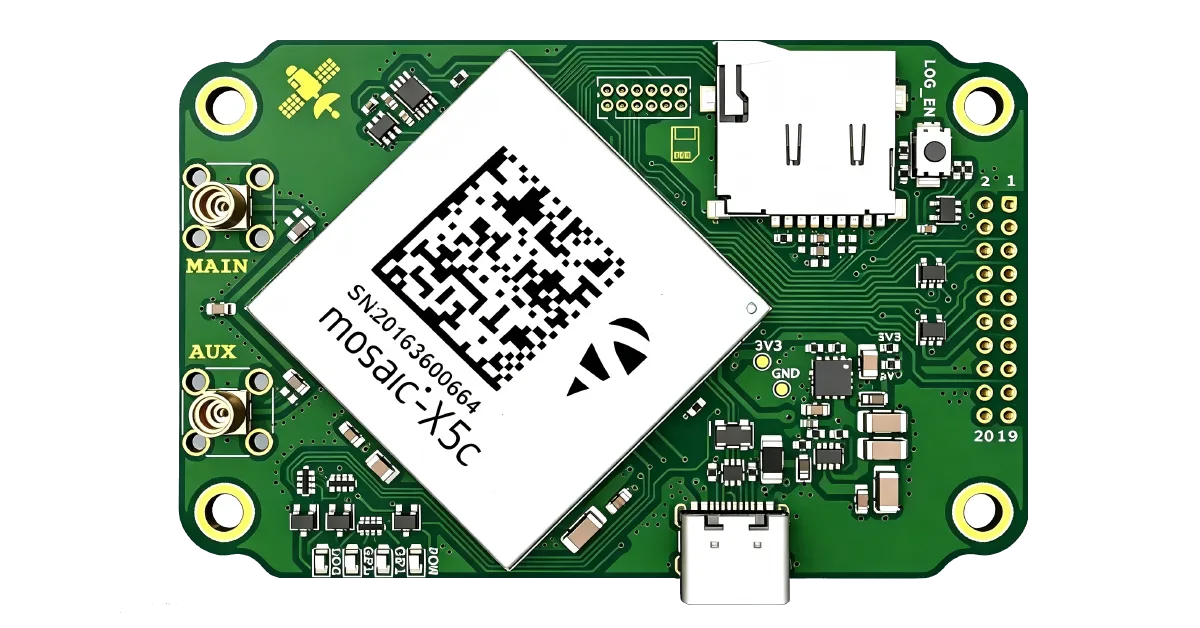
The BASE-X5A (QM5002B) is a dual-role positioning module: the same board runs as a local base station broadcasting RTCMv3 corrections, or as a rover consuming CORS corrections over NTRIP. Both roles share one Septentrio Mosaic-X5 multi-constellation engine that tracks GPS, GLONASS, Galileo, BeiDou and QZSS across L1/L2/L5 and holds RTK-Fixed status while the machine is moving.
Integration is deliberately open. Observation and correction data leave the module as NMEA-0183, SBF or RTCM, and dual-virtual-COM micro-USB, Ethernet and multiple 3.3 V TTL UARTs connect straight to mainstream flight controllers and industrial MCUs. An industrial-grade IMU with dynamic sensor fusion keeps heading and position usable when satellites drop out, while wide-band interference mitigation with three automatic notch filters and code/carrier-phase multipath suppression keep the solution stable in harsh RF. Configurable 1PPS output and external event triggers time-stamp position snapshots for multi-sensor alignment.
Multi-frequency, multi-constellation high-precision GNSS evaluation platform with full RTK capability, hardware anti-interference, and a complete host-side toolchain.
GPS, GLONASS, Galileo, BeiDou, QZSS and more — with Stand-Alone, DGPS, SBAS, RTK and PPP positioning modes.
Operates as a base station outputting RTCMv3 corrections, or as a rover with CORS via NTRIP for centimeter-level RTK-Fixed positioning.
Configurable NMEA-0183, proprietary SBF raw observations and RTCM corrections — plus TF-Card offline logging.
Wide-band interference mitigation, 3 auto notch filters and code/carrier-phase multipath suppression for harsh environments.
Configurable 1PPS output and external event triggers to tag position snapshots for multi-sensor time alignment.
Micro-USB dual virtual COM + Ethernet, multiple 3.3V-TTL UARTs for direct MCU and flight-controller integration.
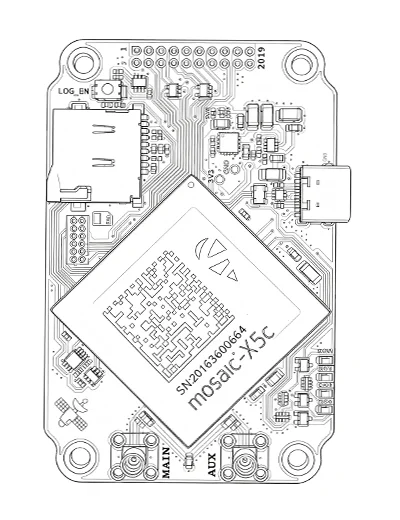
| Supported Constellations | GPS, GLONASS, Galileo, BeiDou, QZSS, SBAS, IRNSS | Multi-constellation reception for reliable positioning in challenging environments |
|---|---|---|
| Positioning Modes | StandAlone, DGPS, SBAS, RTK (Base/Rover), PPP | From single-point to RTK-Fixed centimeter-level positioning |
| Interfaces | Micro-USB · TTL UART · MMCX · TF-Card · PPS/Event | Micro-USB (2 virtual COM + Ethernet); multiple 3.3V TTL UARTs; MMCX antenna; TF-Card slot; PPS & event IO |
| Data Formats | NMEA-0183, RTCMv2/v3, SBF | SBF convertible to RINEX / ASCII / KML for post-processing |
| Timing | Configurable 1PPS | Selectable GNSS time reference source for synchronization |
| Interference Mitigation | WBI + 3 notch filters | Wide-band interference mitigation, auto notch filters, code & carrier-phase multipath mitigation |
| Configuration | RxControl · Web UI · CLI | Web UI (192.168.3.1), RxControl and command console; persistent boot config |
| Pin 1 | EventB_3V3 |
|---|---|
| Pin 2 | VDD |
| Pin 3 | D- |
| Pin 4 | D+ |
| Pin 5 | ADV_M_RST |
| Pin 6 | COM3_TX |
| Pin 7 | COM3_RX |
| Pin 8 | COM4_TX |
|---|---|
| Pin 9 | EventA_3V3 |
| Pin 10 | NC |
| Pin 11 | COM1_TX |
| Pin 12 | COM1_RX |
| Pin 13 | COM2_TX |
| Pin 14 | COM2_RX |
| Pin 15 | NC |
|---|---|
| Pin 16 | GPLED |
| Pin 17 | GND |
| Pin 18 | GND |
| Pin 19 | PPS0_3V3 |
| Pin 20 | COM4_RX |
Four field deployments where the integrated IMU holds centimeter-level RTK-Fixed fixes when machines, vegetation or the hull block the sky. Need a fixed reference instead? BASE-G5 is the compact ultra-low-power board in the same Septentrio family, and BASE-X5B adds a native NTRIP server with isolated Ethernet. Comparing the two Septentrio mosaic cores? See the mosaic-G5 vs Mosaic-X5 comparison.
One board serves as the site reference and as the stake-out rover, so the crew keeps RTK-Fixed points while machines and material block the sky.
Configurable 1PPS and external event inputs time-stamp position snapshots against GNSS time, aligning ground-station clocks and multi-sensor logs.
The IMU bridges the gaps when mast and hull hide the satellites, and raw SBF observations logged to the TF card re-process to RINEX, ASCII or KML ashore.
Position and heading leave the board as NMEA-0183 over 3.3 V UART or Ethernet, so autonomous-driving platforms and retrofit projects add RTK-Fixed guidance to an existing vehicle or machine without replacing its controller.



The questions integrators ask before designing in BASE-X5A — answered from the published specification.
GPS, GLONASS, Galileo, BeiDou, QZSS, SBAS and IRNSS, with Stand-Alone, DGPS, SBAS, RTK (base or rover) and PPP positioning modes.
Yes. The same board runs as a local base station broadcasting RTCMv2/v3 corrections, or as a rover consuming CORS corrections over NTRIP for centimeter-level RTK-Fixed positioning.
Micro-USB, 3.3 V TTL UART, MMCX antenna, TF-Card slot and PPS/Event pins. Data leaves the module as NMEA-0183, RTCMv2/v3 or SBF raw observations.
Wide-band interference mitigation with 3 automatic notch filters, plus code and carrier-phase multipath suppression for harsh environments.
Through RxControl, the built-in web UI or the command-line interface; the configuration persists across reboots.
A configurable 1PPS output and external event triggers, so position snapshots can be time-stamped against GNSS time for multi-sensor alignment.
Yes. The same board runs as a local base station broadcasting RTCM v2/v3 corrections or as a rover consuming them, so several BASE-X5A units can serve as reference stations in a multi-base GNSS network. It tracks GPS, GLONASS, Galileo, BeiDou, QZSS, SBAS and IRNSS across L1/L2/L5 with an integrated 6-DOF IMU.
Goods are quoted FOB Shanghai Airport. The default carrier is DHL Economy, freight is prepaid by the seller and added to the invoice, and delivery to the airport is free of charge. Air freight takes 7–10 days and express courier 3–5 working days, depending on the destination region and the carrier’s official tracking. Main markets are Europe, the Middle East, the USA and South America; shipping is worldwide.
Discounts are granted at the seller’s discretion according to the project volume. For special projects and long-term partners, terms and pricing are negotiable — tell us the expected volume and the deployment plan and we will quote accordingly.
Every unit carries a 2-year warranty from the shipment date: defects caused by the product itself are repaired or replaced free of charge, and human damage is charged at parts cost only. Mechanical spare parts are guaranteed to be available for 15 years (cellular modules and batteries follow the upstream supplier’s policy). International returns and replacements follow a written RMA process — request within 15 business days, and never ship goods back before we approve the return and issue an RMA number. Duties, freight and other return costs are allocated according to the cause, and a return whose total cost exceeds 15% of the goods’ value may be refused or settled locally instead. Read the full quality-assurance and return policy.
This website provides information about Qumtrix's IoT engineering, OEM/ODM development and manufacturing services.
The text, images, logos, graphics and technical content on this site belong to Qumtrix or the relevant rights holders and may not be copied or used commercially without authorisation.
Product specifications, technical information and other content on this website are provided for general informational purposes and may be updated without prior notice.
We are not responsible for the content or availability of third-party websites.
We make reasonable efforts to keep the information on this website accurate and up to date, but we do not warrant that all information is complete, current or error-free.
For questions regarding these Terms of Use, please contact us at sales@qumtrix.com.
When you send an inquiry or a partner application: company, your name, business e-mail, country, the products or quantities you are interested in, your message and an optional phone number. When you subscribe: your e-mail address. For anonymous statistics: the page, an approximate country, reading time and clicks.
To answer your inquiry and perform our contract (Art. 6(1)(b)), and for anonymous statistics under legitimate interests (Art. 6(1)(f)) which you can switch off at any time. Analytics details are deleted after 400 days, the full IP address is masked after 30 days, audit logs after 730 days.
Access, correction, export, deletion, objection and restriction. Write to admin@qumtrix.com — we answer within 30 days.
qumtrix.com sets no advertising or tracking cookies. Visits are counted anonymously — page, approximate country, reading time, clicks — with no cookie and nothing stored on your device for measurement.
qm_cookie_consent in your browser's local storage remembers whether you switched statistics on or off. It is strictly necessary, stays on your device and is never sent to us.
Use Cookie settings in the footer at any time; switching statistics off takes effect immediately and no further measurement is sent. Do Not Track and Global Privacy Control are always honoured.
Every unit carries a 2-year warranty from the shipment date. Defects caused by the product itself are repaired or replaced free of charge; damage caused by human factors that needs parts replaced is charged at parts cost only. Mechanical spare parts are guaranteed to be available for 15 years.
Send a written request with the order number, product details, quantity, reason and supporting documents (photos, video, test data) within 15 business days after the issue is found. No goods may be returned without our written approval and an RMA number.
Return freight, destination duties and re-assessed Chinese import duties and VAT follow who is at fault. If the total return cost exceeds 15% of the goods' residual or contract value, we may refuse the return or ask you to dispose of the goods locally, at your cost.