BASE-G5: Multi-Band RTK GNSS Board with Dual-Antenna Heading
Powered by the Septentrio mosaic-G5 engine, the BASE-G5 delivers centimeter-level RTK accuracy and 0.15° dual-antenna heading without magnetic distortion. Built with AIM+ anti-jamming technology and ultra-low power consumption, it is engineered for rapid integration into drones, robotics, and precision surveying platforms.
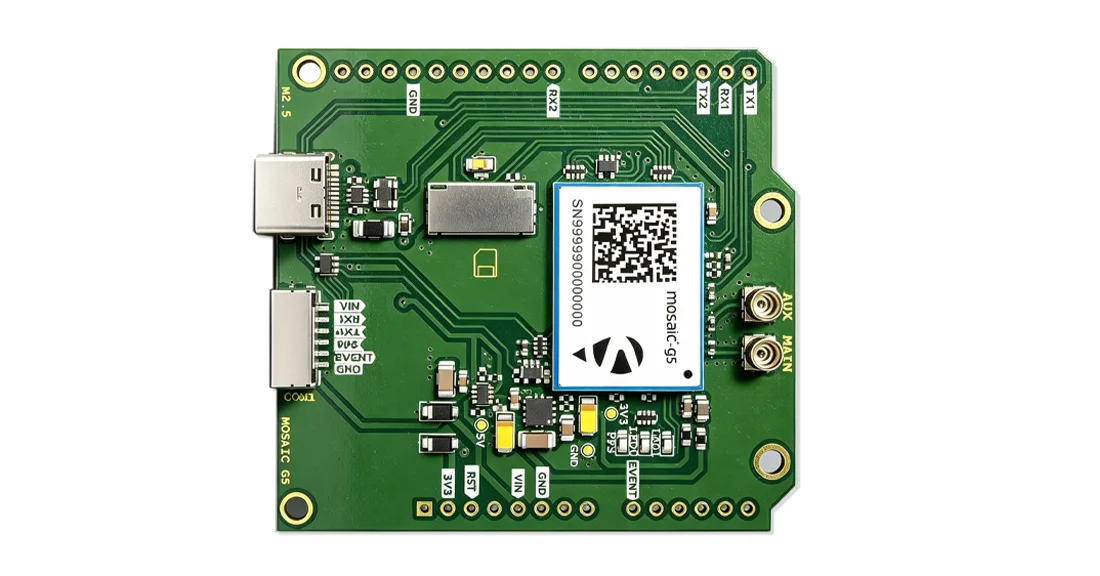
Product Overview
Compact All-Constellation RTK Engine for Base & Rover Applications
The BASE-G5 (built on the Septentrio mosaic-G5) is a plug-and-play hardware front end for demanding autonomous platforms and RTK base stations. Tracking full-constellation signals across the L1/L2/L5 bands keeps centimeter-level fixes stable in urban canyons and other multipath-heavy environments, and the same board serves either role — fixed reference or moving rover.
To guarantee mission-critical reliability, the board integrates Septentrio’s firmware suite — LOCK+ for heavy-vibration environments, IONO+ for ionospheric activity, and APME+ for multipath reduction. Integrated USB-C, dual UART ports, 1PPS/Event triggers and local TF-card raw logging ensure drop-in compatibility with flight controllers, industrial PLCs and survey base stations.
Key components
- Septentrio mosaic-G5
- L1/L2/L5 tri-band
- GPS/GLONASS/Galileo/BeiDou/QZSS/NavIC/SBAS
- AIM+ anti-jamming & anti-spoofing
- P3H dual-antenna heading (0.15°)
- Up to 20 Hz RTK output
- 5 ns timing
- USB-C + dual UART + TF-card logging
- 22 × 16 mm · ≈0.44–0.6 W
Core Advantages
AIM+ RF Security & Anti-Spoofing
- Jamming: actively detects & suppresses narrowband CW and wideband/pulsed interferer signals.
- Anti-spoofing: rejects malicious spoofed signals for trustworthy positioning.
- Spectrum: real-time RF interference monitoring via the Web UI.
Full-Constellation Tri-Band Tracking
- Systems: GPS / GLONASS / Galileo / BeiDou / QZSS / NavIC / SBAS — no coverage blind spots.
- Bands: L1 / L2 / L5 tri-band tracking across high-performance frequencies.
- Urban: stronger multipath resilience than dual-band in city canyons.
Centimeter Precision & P3H Heading
- Rate: up to 20 Hz RTK output for UAV, robotics & fast-moving platforms.
- Precision: centimeter-level RTK with 0.15° heading accuracy.
- Heading: P3H dual-antenna, magnetometer-free — valid while stationary.
Advanced Signal & Environment Mitigation
- LOCK+: vibration-robust tracking for heavy machinery & multi-rotor drones.
- IONO+: mitigates ionospheric scintillation during high solar activity.
- APME+: reduces multipath reflections from buildings & ground.
Ultra-Compact Footprint & Low Power (~0.5 W)
- Power: ≈0.44–0.6 W typical — highly efficient for RTK.
- Size: all GNSS logic in a 22×16 mm module footprint.
- Integration: simplified RF design for compact product integration.
Where G5 and X5 each win
| mosaic-G5 | Mosaic-X5 | |
|---|---|---|
| Bands | L1 / L2 / L5 (multi-band) | L1 / L2 / L5 + L6 |
| Constellation | GPS / GLONASS / Galileo / BeiDou / QZSS / NavIC / SBAS | Same full multi-constellation |
| Anti-jamming | AIM+ anti-jamming & anti-spoofing | AIM+ anti-jamming & anti-spoofing |
| RTK rate | Up to 20 Hz | Up to 20 Hz |
| Heading | P3H dual-antenna, magnetometer-free | Dual-antenna (model-dependent) |
| Timing | Solid timing (5 ns) | Extreme timing performance |
| Power / size | ≈0.44–0.6 W · 22×16 mm | Higher power (L6 adds demand) |
| Positioning | Multi-band & price/performance sweet spot | L6 + timing-critical applications |
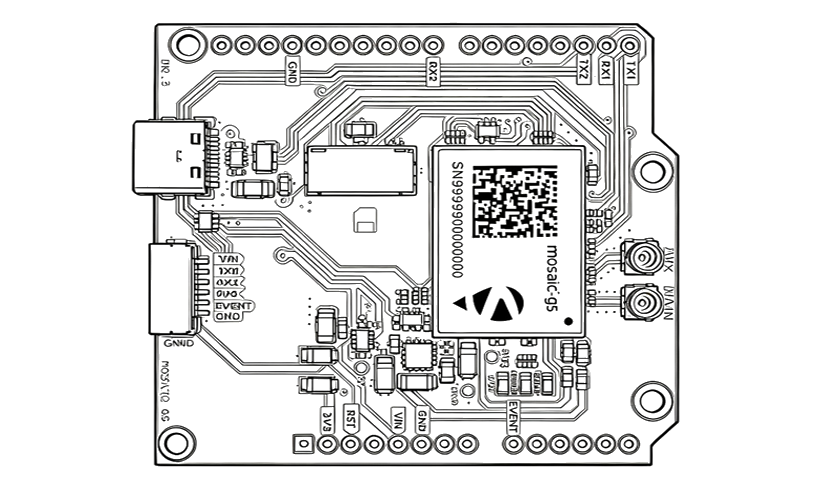
Configuration
| Module | Septentrio mosaic-G5 | Multi-band multi-constellation RTK GNSS receiver |
|---|---|---|
| Constellation | BeiDou / GPS / Galileo / GLONASS | QZSS & SBAS supported, centimeter-level RTK |
| Anti-interference | AIM+ | Built-in anti-jamming & anti-spoofing for harsh RF |
| Interfaces | USB-C / Dual-UART / TF | Dual-SMA antenna, raw data logging to TF card (max 32GB) |
| Power Input | 5V USB-C | USB-C or external VIN supply |
| Operating Temp | −40°C to +75°C | Industrial wide-temperature operation |
GNSS
| Frequency Bands |
GPS: L1C/A, L1C, L2C, L2P(Y), L5 · GLONASS: L1CA, L2CA, L2P, L3 CDMA Galileo: E1, E5a, E5b, E6 · BeiDou: B1I, B1C, B2a, B2I, B2b, B3I QZSS: L1C/A, L1C, L1S, L2C, L5, L6 · NavIC: L5 SBAS: EGNOS, WAAS, GAGAN, MSAS, SDCM (L1, L5) |
|
|---|---|---|
| Positioning | RTK cm-level | Horizontal 0.6 cm + 0.5 ppm; vertical 1 cm + 1 ppm |
| Init Time | < 7 s | Typical time to first RTK fix |
| Heading | 0.15° (1 m) / 0.03° (5 m) | 0.15° @ 1 m baseline; 0.03° @ 5 m baseline |
| Time Sync | PPS / EVENT | Nanosecond-level PPS output, EVENT time-mark input |
| Timing | 5 ns | Timing / 1PPS accuracy |
| Antenna | MAIN / AUX | Dual antenna input for heading calculation |
| Application | AGV / UAV / Surveying | Autonomous machinery, robotic automation, RTK base station |
| I/O | 2x UART, USB 2.0, TF; 2x Event In, 2x GPIO, 2x PPS | 2x UART · USB 2.0 HS · TF card (max 32GB); 2x Event, 2x GPIO, 2x PPS out |
| Protocols | NMEA, RINEX, SBF, RTCM v2.x/3.x | Data formats & protocols supported |
Quick Web Configuration Tool
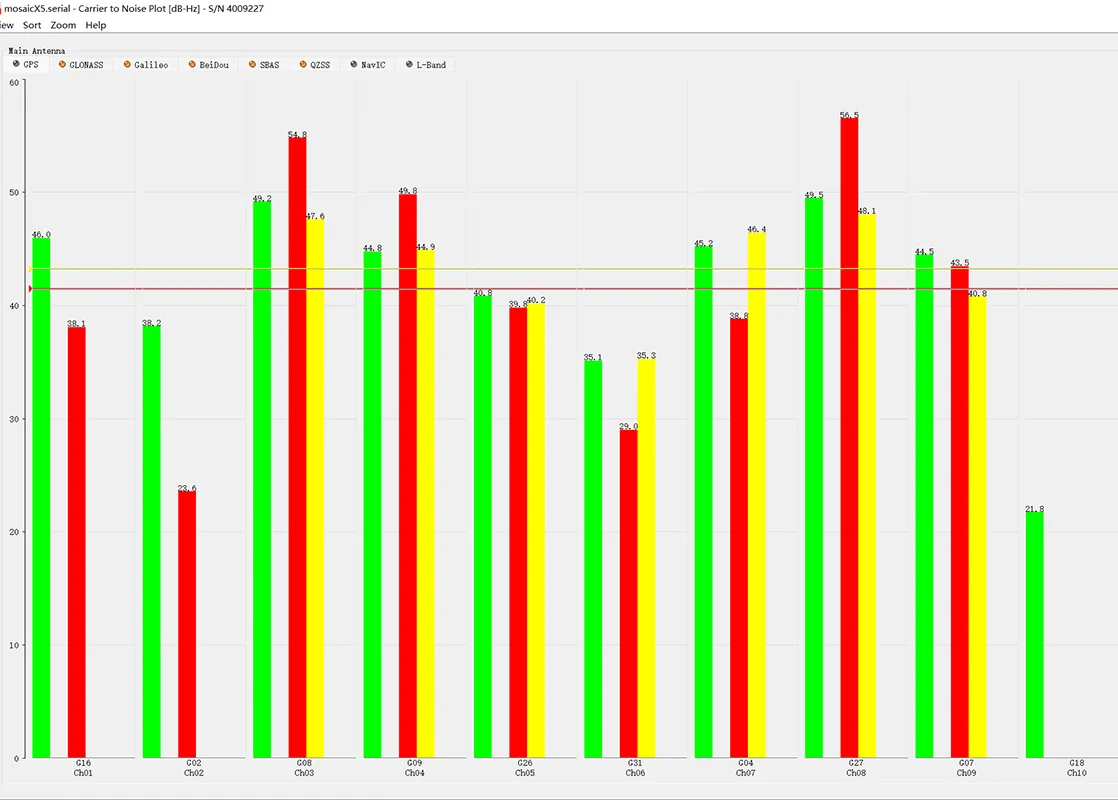
Configure your module locally in the browser — no cloud account, no software install.
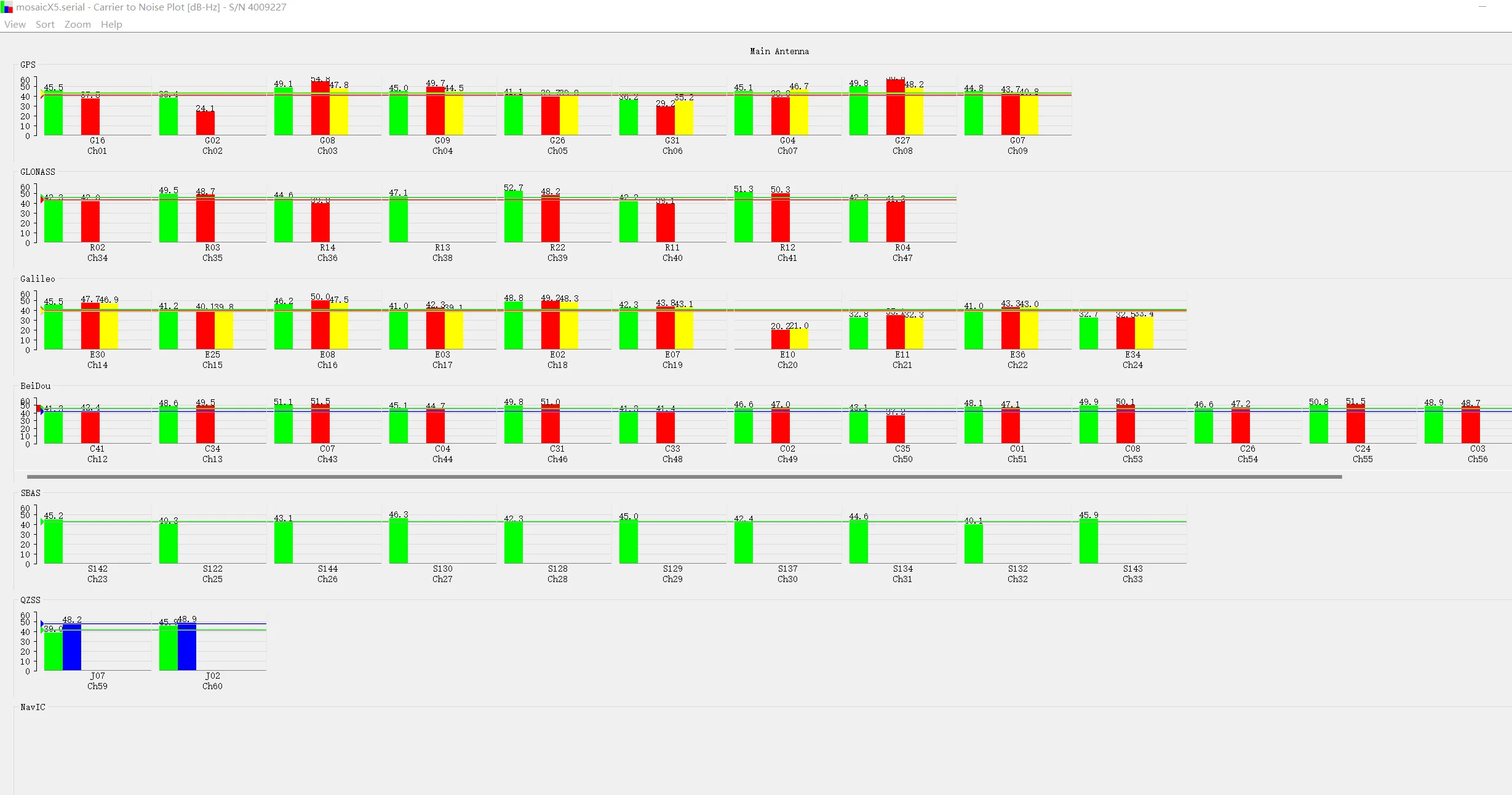
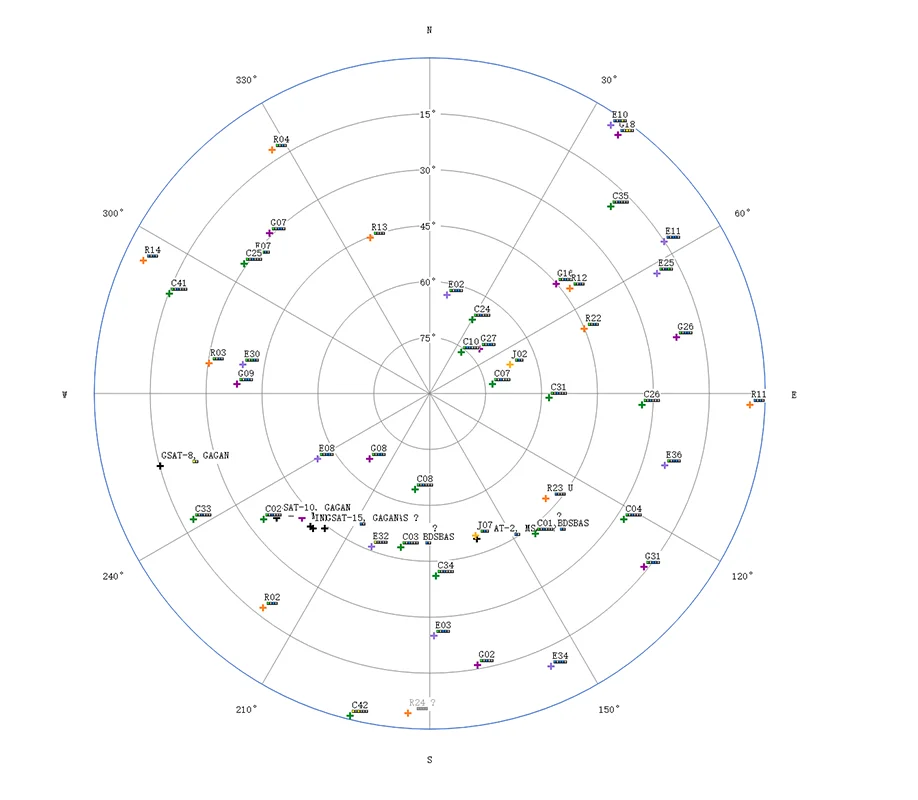
Multi-Base GNSS Station
Fixed and Portable Reference
Three deployments that run on the same Septentrio mosaic-G5 board — fixed reference, moving rover, or both at once. Comparing base boards? BASE-X5B adds a native NTRIP server and isolated Ethernet, while BASE-X5A pairs the same RTK core with an integrated 6-DOF IMU.
-
01
RTK Surveying
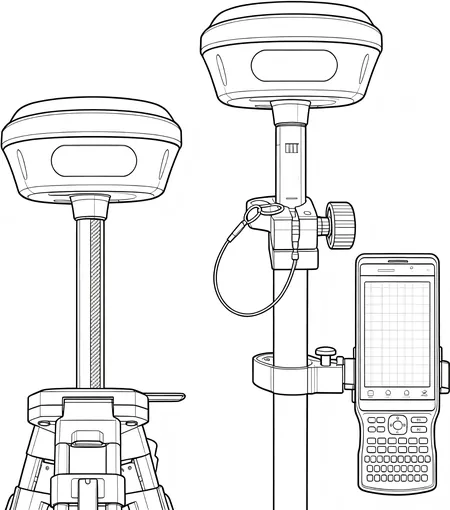
Covers both ends of a survey — a fixed reference on the tripod and a moving rover on the pole — with L1/L2/L5 tri-band tracking that holds centimeter-level fixes steady through building and ground multipath.
-
02
UAV Surveying
Up to 20 Hz RTK output goes straight to the flight controller over USB-C or dual UART, while LOCK+ keeps tracking through the vibration of multi-rotor flight.
-
03
Precision Agriculture
LOCK+ vibration-robust tracking and magnetometer-free P3H heading keep guidance true on heavy machinery, at a typical draw of ≈0.44–0.6 W that the machine’s own supply can carry.


Technical FAQ
The questions integrators ask before designing in BASE-G5 — answered from the published specification.
What GNSS engine does BASE-G5 use?
The Septentrio mosaic-G5, tracking GPS, GLONASS, Galileo and BeiDou across the L1/L2/L5 bands in a 22 × 16 mm module footprint.
What heading accuracy does the dual-antenna configuration deliver?
0.15° at a 1 m baseline and 0.03° at a 5 m baseline. P3H heading is magnetometer-free, so it stays valid even while stationary.
How fast does it fix and how fast can it output?
Initialisation in under 7 seconds with RTK output up to 20 Hz — enough for UAV, robotics and other fast-moving platforms.
What anti-interference protection does BASE-G5 have?
AIM+ actively detects and suppresses narrowband CW and wideband or pulsed interferers, with anti-spoofing protection.
What are its power and environmental limits?
Powered over 5 V USB-C, with a typical draw of about 0.44–0.6 W and an operating range of −40 °C to +75 °C.
Which interfaces and protocols does it expose?
2× UART, USB 2.0, TF card, 2× event inputs, 2× GPIO and 2× PPS, with NMEA, RINEX, SBF and RTCM v2.x/3.x; PPS/EVENT time sync is accurate to 5 ns.
Can BASE-G5 be used as a multi-base GNSS station?
Yes. BASE-G5 outputs RTCM v2.x/3.x and NMEA over 2× UART and USB 2.0 with PPS/EVENT time sync accurate to 5 ns, so several boards can run side by side as reference stations in a multi-base GNSS network. Each board is also a complete multi-frequency base station, tracking L1/L2/L5 at a typical draw of about 0.44–0.6 W.
What are the shipping terms, the freight and the delivery time?
Goods are quoted FOB Shanghai Airport. The default carrier is DHL Economy, freight is prepaid by the seller and added to the invoice, and delivery to the airport is free of charge. Air freight takes 7–10 days and express courier 3–5 working days, depending on the destination region and the carrier’s official tracking. Main markets are Europe, the Middle East, the USA and South America; shipping is worldwide.
How are volume discounts and special projects handled?
Discounts are granted at the seller’s discretion according to the project volume. For special projects and long-term partners, terms and pricing are negotiable — tell us the expected volume and the deployment plan and we will quote accordingly.
What is your quality-assurance and return policy?
Every unit carries a 2-year warranty from the shipment date: defects caused by the product itself are repaired or replaced free of charge, and human damage is charged at parts cost only. Mechanical spare parts are guaranteed to be available for 15 years (cellular modules and batteries follow the upstream supplier’s policy). International returns and replacements follow a written RMA process — request within 15 business days, and never ship goods back before we approve the return and issue an RMA number. Duties, freight and other return costs are allocated according to the cause, and a return whose total cost exceeds 15% of the goods’ value may be refused or settled locally instead. Read the full quality-assurance and return policy.